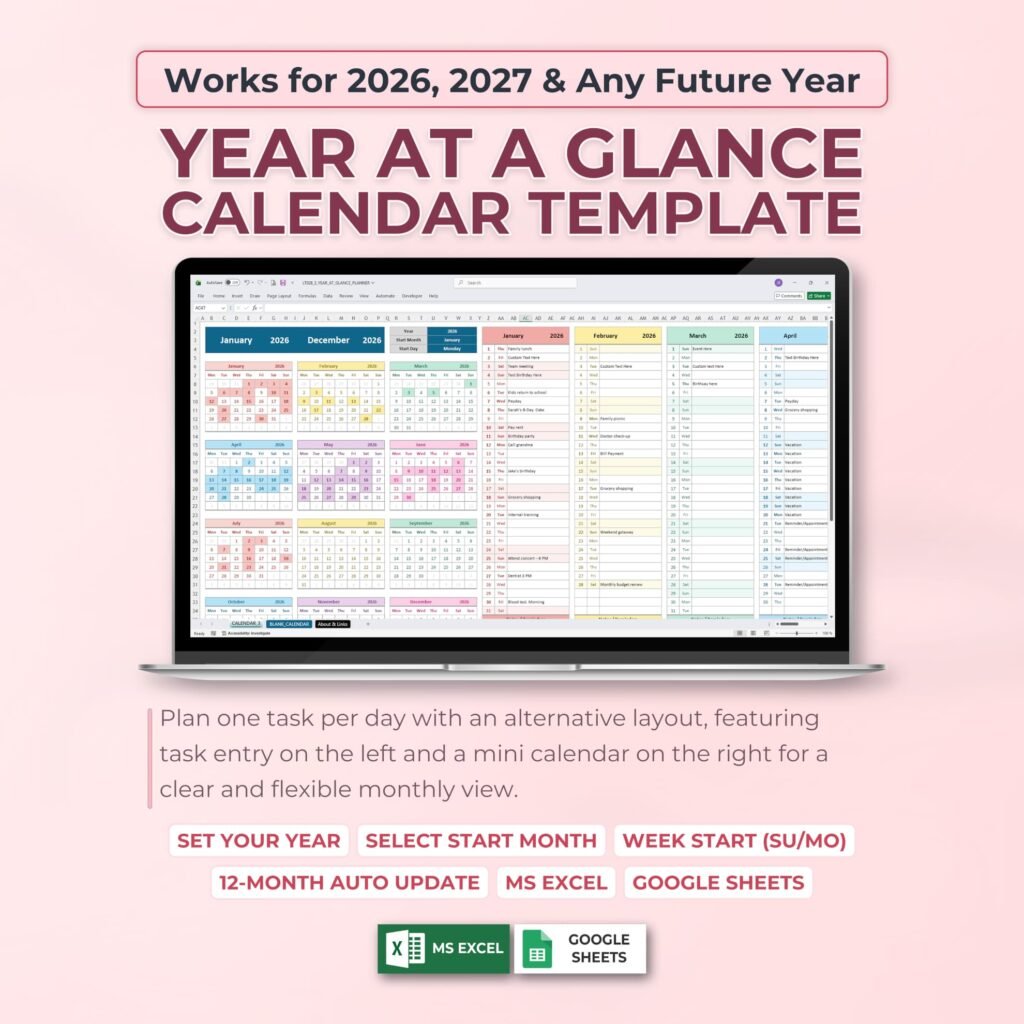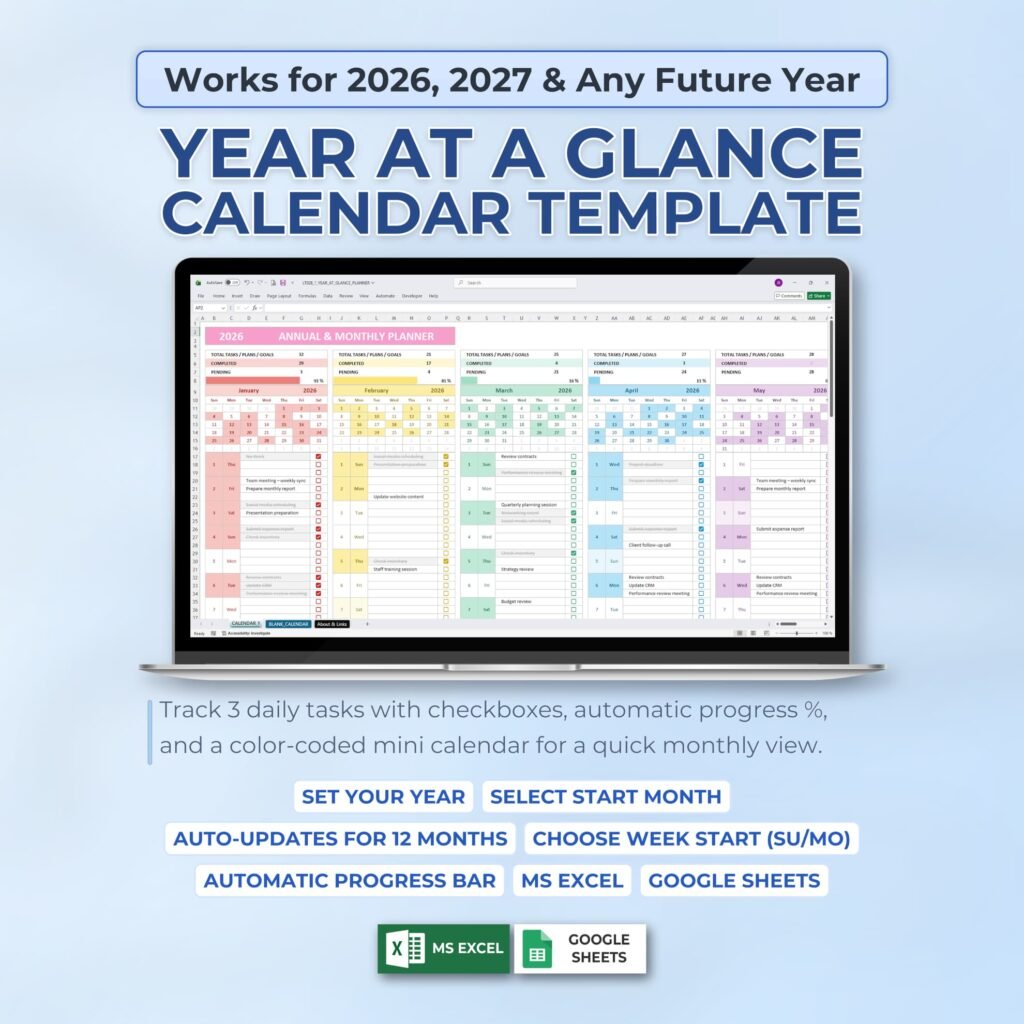
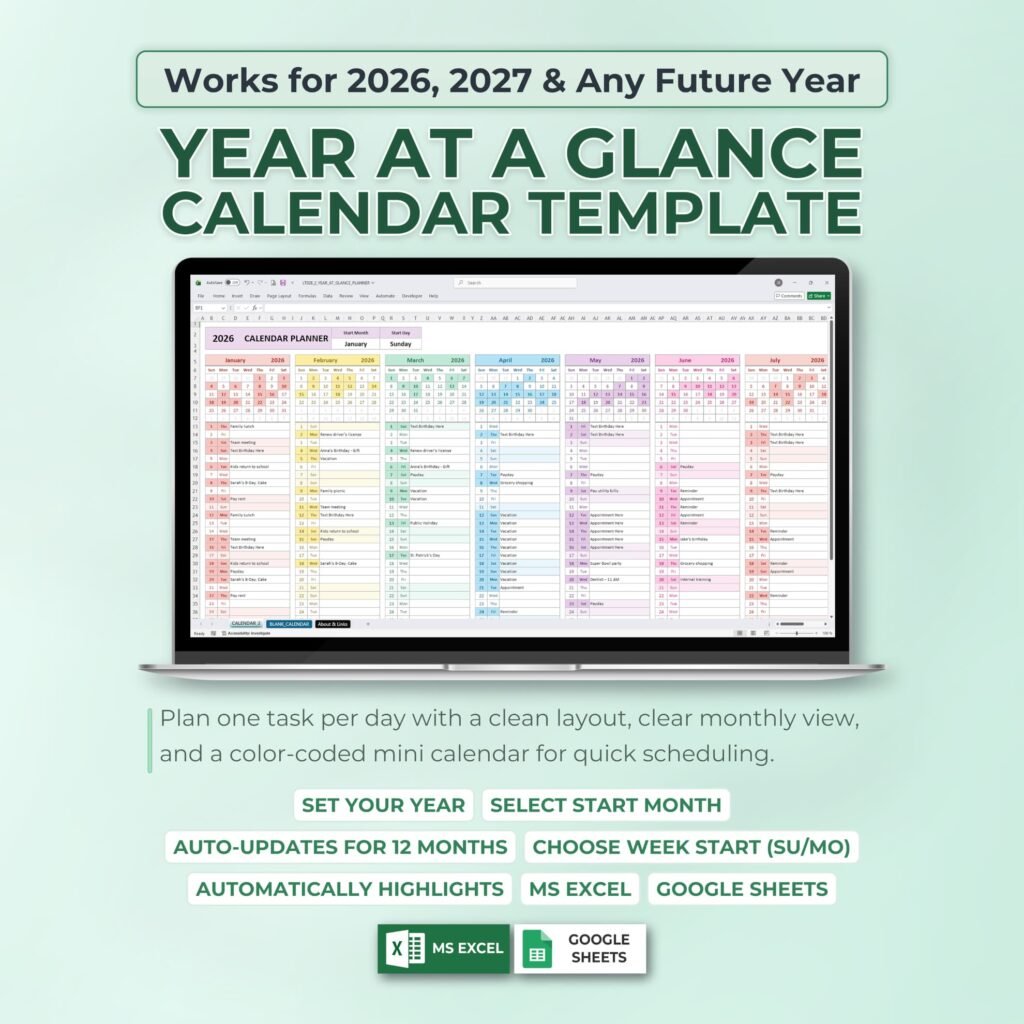
Monthly planning gives you something daily planning cannot: context. A good month plan helps you see deadlines, appointments, recurring responsibilities, and goals before they all compete for your attention at the last minute. Asana’s schedule templates are explicitly positioned for daily, weekly, and monthly planning, and Todoist’s productivity guidance often connects daily tasks back to weekly and monthly goals.
See our calendars:
- Year at a Glance Calendar Planner – Template 1
- Year at a Glance Calendar Planner – Template 2
- Year at a Glance Calendar Planner – Template 3
- Year at a Glance Calendar Planner – Template 4
- Full Year Organizer Bundle – 4 Year at a Glance Calendar Templates
Why monthly planning works
When you organize your month, you stop making every decision at the daily level. Instead of waking up and asking what to do from scratch, you already know what matters this month and which weeks are likely to be busy. Todoist’s planning guidance recommends looking at your week as a whole before filling your daily list, and the same logic applies even more strongly at the monthly level.
A monthly view helps you break larger goals into smaller actions and avoid the feeling that everything is urgent all at once.
Start with your key dates and fixed commitments
The first step in organizing your month is to place the things that are already fixed: appointments, travel, events, deadlines, recurring tasks, and important reminders. A reusable planning template works well here because it gives structure without forcing you to rebuild the month from zero each time. Asana’s schedule template guidance highlights exactly that benefit: planning faster with built-in structure and adapting the same template across timeframes.
Once the fixed items are visible, the month becomes easier to shape around them.
Break monthly goals into daily actions
Longer-term goals are easier to achieve when they are broken into visible next steps. Todoist’s goal-tracking guidance recommends keeping high-level goals visible all year and turning them into concrete tasks, while Asana’s goal-setting and annual-planning resources focus on connecting large objectives to day-to-day execution.
That is one reason monthly planner layouts are so useful. They help you move from “I want to make progress this month” to “Here is what I actually need to do this week.”
Use a format that matches your planning style
Not everyone plans the same way. Some people want one simple daily entry. Others need room for multiple tasks, plans, or goals per day. A better monthly planning system is not necessarily more detailed. It is the one that matches how you think and work.
Public template ecosystems reflect this. Asana offers schedule templates for different timeframes and workflows, while Todoist’s methods range from minimalist systems like the Ivy Lee Method to broader structures like GTD and the 1-3-5 Method.
That makes template choice part of the strategy, not just a design preference.
Review progress during the month
A monthly plan is not something you create once and forget. Todoist’s “Don’t Break the Chain” and goal-tracking resources emphasize consistent review and measuring progress over time, and Asana’s planning resources do the same through milestones, templates, and structured review systems.
A simple mid-month check-in can help you answer:
- what is completed
- what is still pending
- what no longer matters
- what needs to move into next week
That keeps the month useful instead of static.
Keep your monthly plan visible
The more visible the plan, the easier it is to follow. Calendar-style layouts help because they let you review your month at a glance instead of hiding everything inside long task lists. Google Calendar describes its product as a way to stay on top of plans across work and home, and Asana similarly emphasizes calendar and timeline views for visualizing schedules.
That is especially helpful when you are trying to balance recurring tasks, personal appointments, and monthly goals in one place.
Final thoughts
If you want to organize your month for productivity, start by creating a visible monthly view, placing fixed commitments first, and breaking your bigger goals into smaller daily actions. A good monthly planner reduces decision fatigue, helps you see the month clearly, and makes your daily planning much easier. The strongest planning systems all do the same thing: they connect long-term goals to daily execution through a repeatable structure.